Our Approach
Mein Ansatz ist einfach: Zuerst den echten Arbeitsablauf verstehen, dann mit dem richtigen Technologieeinsatz verbessern.
Nicht jedes Problem braucht ein komplexes System oder eine KI-Lösung. Manchmal kommt die größte Verbesserung von einem klareren Prozess, einer besseren Excel-Datei, einer kleinen Automatisierung oder der Verknüpfung bereits verfügbarer Werkzeuge.
Der Prozess beginnt mit dem Verständnis, wie die Arbeit derzeit erledigt wird, wo Zeit verloren geht, wo Fehler passieren und was das Unternehmen tatsächlich benötigt. Von dort aus erstelle ich einen praktischen Verbesserungsplan, helfe bei der Entscheidung, welche Technologie sinnvoll ist, baue oder konfiguriere die Lösung und unterstütze sie nach der Implementierung.
Das Ergebnis ist nicht nur eine technische Lösung. Es ist eine funktionierende Verbesserung, die sich in den täglichen Geschäftsablauf integriert und sich im Laufe der Zeit weiterentwickeln kann.

Initial Call
The first step is a short conversation to understand your situation, your goals, and the problem you want to solve. We look at where work feels slow, manual, unclear, or unnecessarily complicated, and decide whether the topic is a good fit.
This call is not about selling a solution immediately. It is about understanding what is happening and whether there is a practical way to help.
Workflow Analysis
The current way of working is reviewed from start to finish. This includes the steps, handovers, tools, files, responsibilities, recurring manual tasks, and places where delays or mistakes appear.
The goal is to make the existing process visible before changing anything. Once the workflow is clear, the real bottlenecks and improvement opportunities become much easier to identify.

Improvement Plan
The findings are turned into a practical improvement plan. This shows what can be simplified, automated, removed, documented, or improved, and which changes should be handled first.
For quality-managed or ISO-related processes, existing documentation, responsibilities, and compliance requirements can also be considered, so improvements support the way the process needs to be controlled.
Technology Decision
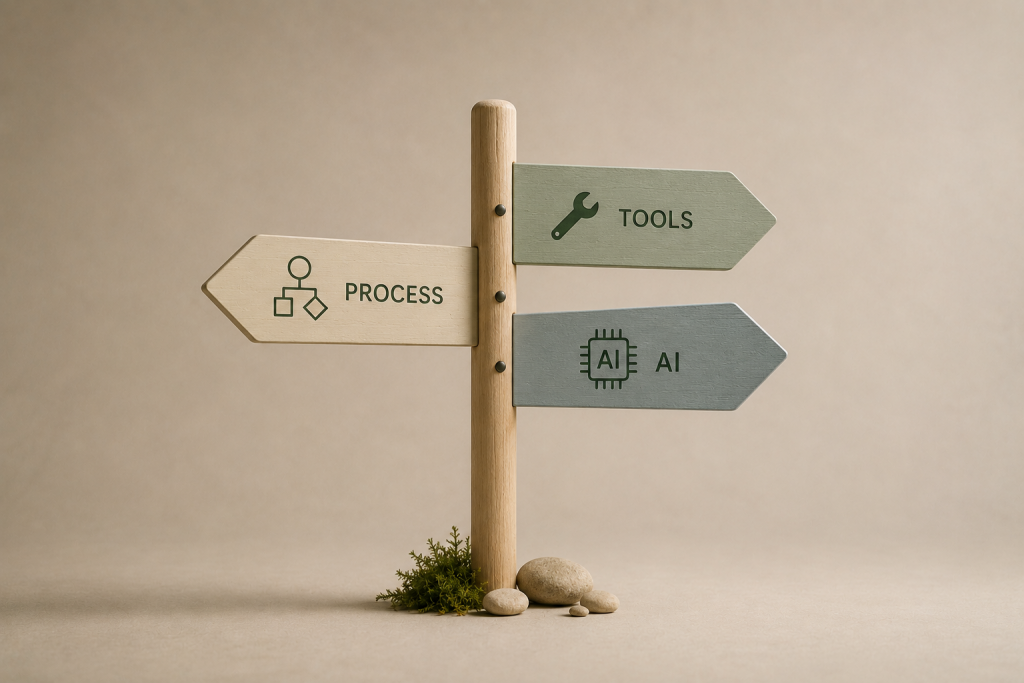
Before building anything, the right type of solution is selected. Sometimes the best answer is a clearer process. Sometimes it is a cleaned-up spreadsheet, an existing tool, automation, AI support, or a small internal tool.
The focus is on choosing the simplest solution that creates real value, instead of adding technology just because it is possible.

Concept & Scope
Once the direction is clear, the solution is defined in more detail. This includes what will be changed or built, what is included, what is not included, which tools will be used, and how success will be measured.
This step keeps the project focused and avoids unnecessary complexity before implementation begins.
Implementation
The agreed solution is built, configured, cleaned up, or improved. Depending on the project, this can mean improving a spreadsheet, setting up automation, implementing an AI-supported step, or building a small internal tool.
The implementation is kept practical and close to how the team actually works, so the result is useful in daily business rather than just technically impressive.


Testing & Handover
Before the solution is handed over, it is tested and refined. The goal is to make sure it works as expected, is understandable for the people using it, and fits the original scope.
You receive clear guidance, notes, or documentation so the solution can be used confidently after the project is complete.
Ongoing Support
After implementation, processes and tools often need small adjustments as the business changes. Ongoing support keeps the solution useful, reliable, and aligned with new requirements.
This can include regular check-ins, small improvements, troubleshooting, documentation updates, and planning the next opportunities for improvement.